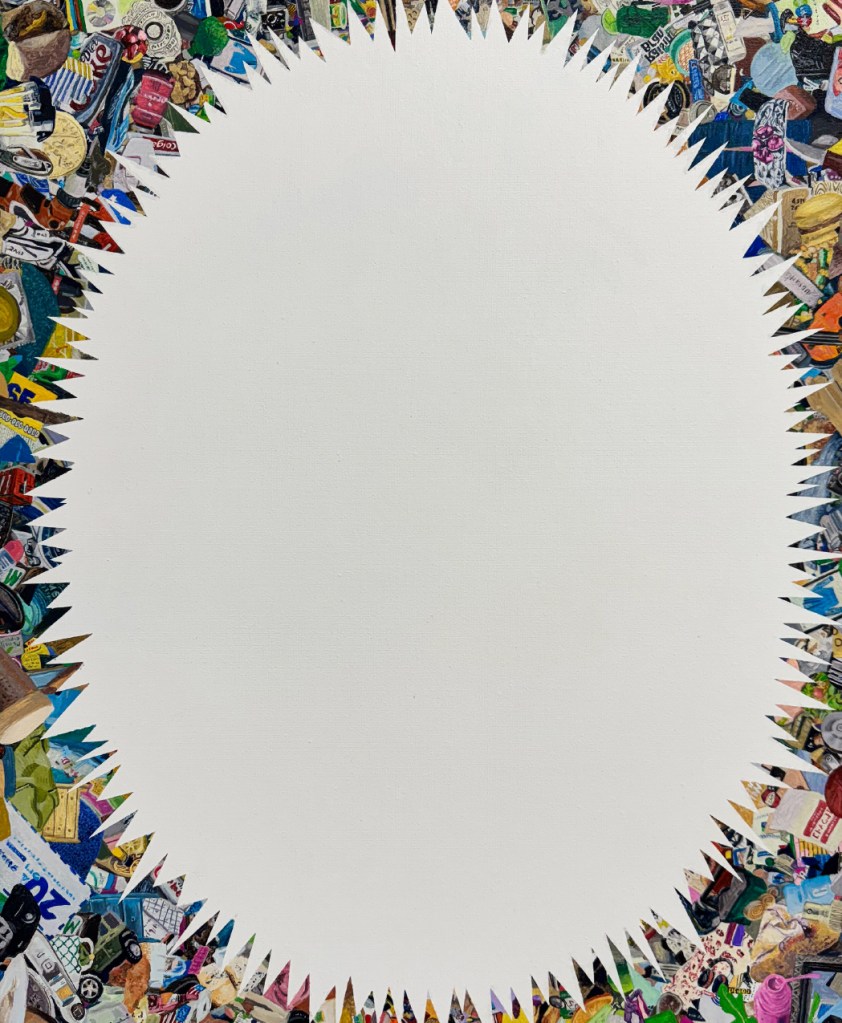
Embrace the Void. It’s no place to build a home, but somewhere anyone who aspires to create art will necessarily endure a stay of uncertain duration. Big Score No. 3 has arrived… with cover painting, “Aah,” by Tom Friedman.
Mark your calendars: our launch will be on Saturday, 10/10, at Gallery 198 in Brooklyn from 6:30 to 9 p.m., featuring readings by Ellen Whiteside, Matilda Lin Berke, Robert Frankel, Diane Mehta, Matt Proctor, Damon Pham, Joshua Chaplinsky, and Cleo Aukland.
You can subscribe to or make a single issue purchase of Big Score here. Best way there is to support our mission of compensating up-and-coming writers decently for their work, evaluating submissions independent of platforms, and standing by the value of printed matter.
What’s in Big Score No. 3:
- The Casino Flooding Beneath the Gospel of Luck, a poem by David Anson Lee
- Requiem for the Angiospermae of Delney-9, a short story by Robert Frankel
This is what we know: Delney-9 was so distant and remote, it was more likely to be missed than ever found; it was found by a survey drone gone so hopelessly astray the data was ignored for a century; its readings were so provocative—so heterodox—that, for the first time in a half-millennia, there was tangible excitement amongst the guilds and corporate colloquies; that, upon our approach, the expedition leader noted its optimal location in the star system’s Goldilocks zone and expressed a subtle note of doubt about its excavation; that, returning from the first ground surveys, two away teams failed to sabotage the mining equipment because of the third and were summarily tried and euthanized for treason.
Its system was bountiful with natural resources, and Delney-9 was especially rich in untapped bismuth and osmium. Winged beasts frocked with meter-long plumage soared through crystalline skies tinged pink. Their shadows cut the glimmer of waterways as silver and serpentine as spilled mercury to reveal the glittering motion of fluorescent invertebrates within. Diamond-peaked mountains, the result of some prehistoric cataclysm, pierced the clouds. We can direct you to any simroom, and you could find yourself on Delney-9. Perhaps some of this would awe you.
But the true wonder of Delney-9 was the singing flowers. - Dead Shoes, a poem by Diane Mehta
- Hysteria in Twee: Wes Anderson and the Disappearing Tangible, a critical essay by Matt Proctor
Growing up in Texas, Wes Anderson must have been ostracized or alienated for his aesthetic particularities, or that’s what I imagine. He went to private school but the landscape of Houston mega-freeways was probably not where the ur-affected, nitpicking micromanager par excellence director of The French Dispatch (2021) imagined the fable of his life playing out. As soon as he could, Anderson got out of there for L.A. Then as soon as he could get out of L.A., he went to NYC. Then, as soon as he could get out of NYC, he went everywhere else. Is there a pattern here? I don’t know, I’m really asking.
A part of me wanted to believe when I heard the news that global citizen Wes Anderson had been trapped in an elevator in Los Angeles with James L. Brooks and Luke Wilson after a 30th anniversary screening of his first film Bottle Rocket (produced in 1996 by Brooks and co-starring Wilson) that it was karma for his having seemingly avoided the guys who were his roots since basically the new millennium: he last worked with Wilson on The Royal Tenenbaums released in 2001, and the only film of Anderson’s that Brooks produced was the first, when the elder screenwriter/director served as a sort of Hollywood doula to ‘the boys’ as he called them back then. Now they were stuck on an elevator together in what I don’t think I’m being overdramatic by calling a decaying dystopian Hollywood, almost as if the celebrated director were some pharaoh in danger of getting buried alive with his servants (I know, I know: Brooks was his first patron, not his servant, but allow me the allegory, OK? I’m working on something here, I have ambitions for this thing).
It was following Tenebaums that Wes Anderson fled from the United States, and his career ever since has appeared as a rebuke to his place of origin, a sort of a ‘Fuck you to the old man’ as perhaps his most celebrated character, Gene Hackman’s Royal Tenenbaum, might say. This trip to Hollywood on the anniversary of his 30th year as a director figured as a Prodigal Son Returning Home moment. In addition to the victory lap screenings at the Motion Picture Academy, he was feted with a retrospective concert of music from his films at the Hollywood Bowl, which featured an all-star cast of collaborators, including Bill Murray and Jason Schwartzman. Notably missing were any of the Wilsons, with whom he came up in an apartment in Dallas, Texas. - Communion, a poem by Cela Xiè
- [soluble fish], a poem by Timothy Ashley Leo
- Taddies, a short story by Joshua Chaplinsky
Uncle Pha was the first to arrive pondside. He squatted next to the large, flat stone he’d dragged to the water’s edge, wearing nothing but his breechcloth, the handle of his favorite mallet gripped in a calloused palm.
The rest of the village knew not to interrupt this moment—a personal ritual nested within the greater scope of tradition. An opportunity to acknowledge stillness before the ensuing chaos.
Uncle claimed he could hear the approaching rumble of the taddies days before their arrival. A tsunami of cold, slippery flesh bearing down on the village. He’d put a cauliflower ear to the mud and listen, like a healer verifying the faintest murmur of a heart.
“Soon,” he’d say with a childlike glint in his eyes. His excitement was contagious, jumping from face to face, grin to grin. The little ones brimmed with awe. They’d never known him to be wrong. They were too young. They’d lay their heads against the ground in respectful imitation, exclaiming that they, too, could hear the rumble, just like Uncle.
Every year was the same. During the rainy season, a school of fully developed larvae rode the overflow from the vernal pools, traversing an ephemeral stream of churning milt-froth and discarded yolk-sacs down toward the pond, where they were corralled by the damming of the outflow. He-tads and she-tads fresh from the spawning ground, gender indeterminate pending their final transformation, when the females would grow to dwarf their diminutive counterparts.
But first they’d have to survive the gauntlet of the Spring Harvest. - Rite of Spring, a poem by Benjamin Bartu
- In the Archives of Queer Fiction, a critical essay by A.L. Clausen
In the belly of the Lesbian Herstory Archives (LHA)—past the library in the front room, before the well-loved kitchen, and beneath the Yellow Wallpaper room on the floor above—there lounge bookcases full of pulp fiction. My fellow intern and I are merely the latest in a long line of archivettes to comb through these vintage titles. Pulp by pulp, we deshelve the fruits of the paperback revolution, their bindings losing heart in our hands. Our duties, however, lie in the digital: scanning covers, back and front, and the short, sultry teasers hiding within.
“The strange, erotic compulsions that drive one woman into the arms of another…” —The One Between by Arthur Aldon (1962)
Each novel is a surreal encounter. Their covers are scandalously sapphic, featuring white women stripped down to lingerie, or nothing at all; and yet, they were once sold in drugstores and bus terminals alike. With their spines squatting on the table, their pages of unbleached wood pulp laid bare, I wonder if the archive is not also a mausoleum. For here lies one great contradiction: casual, cheap reads starring Women-Loving-Women (WLW) sold in the red depths of the Lavender scare. How can there be lesbian literature from seventy years past, when today, the likes of Malinda Lo’s Last Night at the Telegraph Club are banned from so many shelves? - Beast Magic, a poem by Ellen Whiteside
- Good Girls, a short story by D.C. Corvino
I only start calling my wife a good girl after she cheats on me, after I move into the office because we can’t afford to break the lease, after the divorce papers are signed but not notarized, after we fight and cry and get too high and I tell her I hate how we never got to try all those things we talked around, playing chicken with our desires—impact play, quickies out in the wild, the threesome we both wanted and neither would admit to—and we hate-fuck and make the list of all the things we lied about wanting. “You owe me this,” I say, and she thinks it’s hot, this assertive energy we’d never explored because I thought she was repressed and she thought I was frigid, because she couldn’t tell the difference between ice and stone, and maybe she wouldn’t have cheated on me if I’d grabbed her hips like this before, but it’s too late, so we say our goodbyes by fucking in all the ways we never did before, back arched, hair pulled, throat deep and gagging on one dildo while I shove the other up her tight little ass and we talk about how we’re going out with a bang, searching for another girl’s dick to suck together. - Mirror, Mirror, a critical essay by Matilda Lin Berke
I have a picture of myself reflected in the big windows of New York Bar, superimposed against the famous Tokyo skyline, which (I hate to tell you) looks like every other sparkling cosmopolis from fifty-two floors up, in snapshot stasis. S stands right out of frame, conspicuously absent. He’d flown twelve hours from Los Angeles just to discover that we were inextricably on the rocks: a fact I’d been trying to defer for the better part of a year.
The process of admitting these things is uniquely hard when you’re young—when a college relationship founded on a high school friendship means that a person has, in total, inhabited almost half of your life.
It’s a long, long, lonely way down. - Vikings, a short story by Cleo Aukland
In mind today there’s a blanket sea, spied from a window with white wooden frames, mottled glass in the upper right pane. The sea is a shimmering thing, gosh gorgeous, diamonds on the blued surface and you wonder if the creatures swimming in it know how lucky they are to catch gems on their backs. Let me tell you: it’s a jubilant blue, ultramarine, sewed with salt and cresting over and over and over. Sky sister, and the only difference is the textured paintbrush which makes the ocean creased.
There are islands too, hosts to tall pines and balsams and firs which drop needles that become soft underfoot. Then the stones before the trees meet the water, sometimes scores of them making up gray rocky beaches, sometimes large, flat, sandy ones, sometimes copper-colored craggy ones with pearly seaweed sucked on and barnacles below, and the tide laps over them to paint lines that change with each wave. On occasion it’s odd to think that the forest should end so abruptly at the ocean, but it does.
And as for the unnatural, there are the boats.
