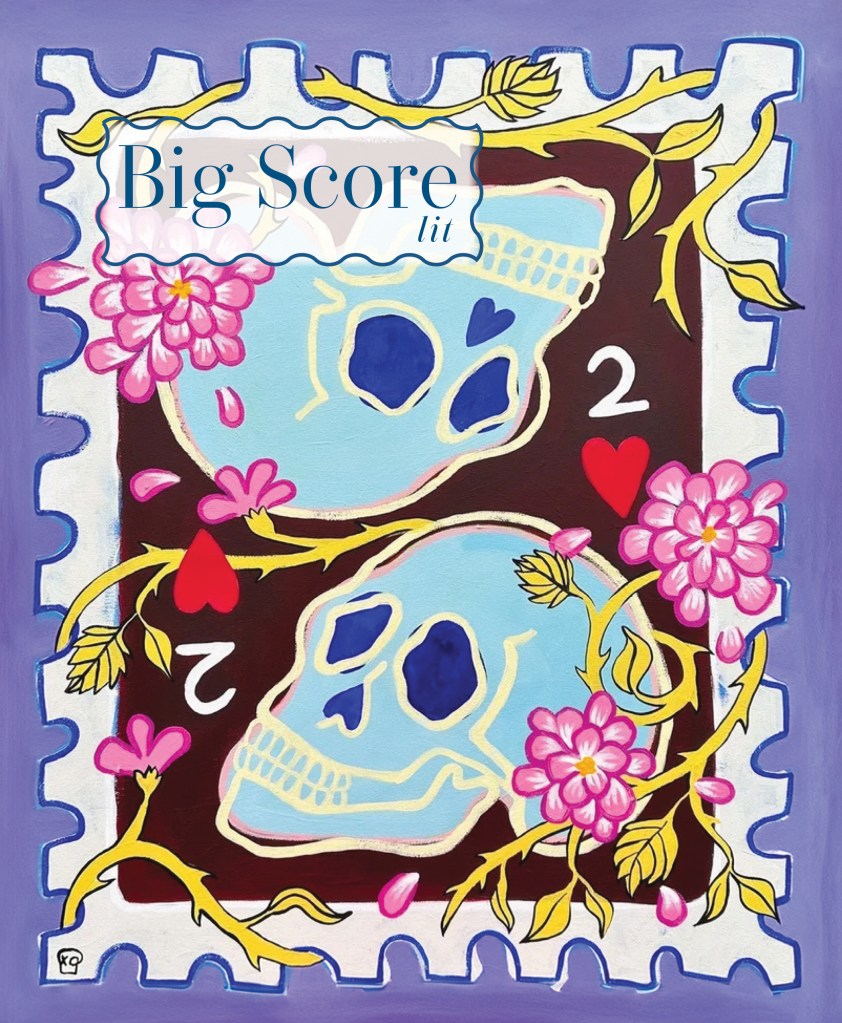
Big Score No. 2 is going to the presses… with cover painting, “Star Crossed Hearts,” by Sophie Rae.
We will be bringing this one into the world in Baltimore. Specifically, at the AWP, where Big Score is set to share a table (T338) with our friends at Excerpt Magazine.
Launch party in Brooklyn details TBD — likely mid-to-late March.
You can subscribe to or make a single issue purchase of Big Score here at right around the cost of two months of Netflix. We’d appreciate your support toward our mission of compensating up-and-coming writers decently for their work, toward evaluating work independent of platforms, toward standing by the value of printed matter.
& if you are sympathetic to what we’re doing here & you’ve got some signal to give, we’d definitely appreciate a little boost.
A preview of Big Score No. 2:
- Scrimshaw I, a poem by Matilda Lin Berke
- The Crewe, a short story by Felicia A. Rivers
LolaLuz hit the streets, slapping her big winky-smiley stickers on the skin of the city. She started with batches of the traditional happy, yellow faces, then quickly branched out into pink, green, blue, purple, black, white, and orange. A grin here. A kissy-wink there. She slapped them on mailboxes, light standards, and telephone poles, blanketing Old City with her little exhortations of joy. Until a woman with blonde bangs and a Burberry coat (“I’m the Vice President of the Old City Civics Association, dontchaknow!”) caught her in the act and flagged down a passing police cruiser. Broken and busted—damn it! Rule #1 of Grrr-illa Street Art: Remain anonymous. Rule #1a: Don’t get caught. LolaLuz was saddled with a $300 fine and a big stinking sack of what-next? - GEESE CONCERT, OR MEN’S RIGHTS RALLY, a poem by MICHAEL CHANG
- A Bunny at the Jackrabbit, a short story by E.J. Leroy
When Crystal responded to the bell for the lineup, she expected to find a man sitting on the sofa with arms folded across his chest, eyes on the merchandise. Instead, the sofa was occupied by a petite olive-skinned woman with long, straight dark hair, a prominent nose, and leopard print glasses. She sat upright with her palms pushed into the sofa as though she was trying to keep it from swallowing her. A duffel bag lay on the floor at her feet. Crystal did her best to hide her surprise. The Jackrabbit had only recently allowed female clients, and few took advantage of the change in company policy. Although Crystal had marketed herself as being “female friendly,” she had never stood in a lineup for one.
Crystal was first in line. She clasped her hands behind her back, stepped forward, and introduced herself.
Before she had a chance to step back, the woman enveloped by the giant sofa pointed at her and said, “You. I’ll take you, if that’s all right.” - Illnesses, a poem by Katherine Cart
- Bell Theories, a poem by Chiwenite Onyekwelu
- I/a verb/you, a poem by Dmitry Blizniuk and translated from Ukrainian by Sergey Gersimov
- cigarettes and madeleines, a travelogue, essay by Moises Ramirez
I witnessed an array of madness in the behavior and demeanor of the temporary residents of this place of leisure. A man with a suitcase, his face struggling to contain a frenzied look, began to add layers of clothing over the extensive clothing he was already wearing. First a dress, then a sweater, then another dress, now a blazer on top of all the prior embellishments. I felt the garden must have been perfumed by a psychedelic mist, and perhaps I wasn’t really seeing what I was seeing. Perhaps a tear in the fabric of the visual universe had revealed itself, as manifested by the man with too many clothes in the park in front of me. - Time Machine parenthesis Sam Elliott voice close parentheses, a poem by Will Keever
- Dutch Masters, a short story by Bo Lewis
Philip and David stand in the Great Hall of the Metropolitan Museum of Art, studying an unfolded floorplan whose edges are furred with wear. It is so humid outside that David’s tortoise-shell glasses fogged when they came through the entrance. Their skin is still clammy from the crosstown walk, and David leans against Philip, as if with enough shared heat their bodies might fuse. Closing his eyes, David nuzzles Philip’s moisture-wicking shirt, a pale blue number more suited to the Appalachian Trail than Fifth Avenue, and inhales the heady scent, which David has teasingly dubbed “eau de flyover”: a mix of Old Spice, Barbasol, and sweat. Summer is almost over. This knowledge glows along the horizon of David’s awareness—more a presence than a thought—and he brushes it from his mind.
Philip says, “Let’s play house.”
“Which room?”
“You choose.” - Hamster, a poem by Damon Pham
- In Flux: on the Archive and Memory, October – November 2023, an essay by Loisa Fenichell
I. On the Archive and the Letter
I hold at once multiple visions of the archive. In philosopher Jacques Derrida’s Archive Fever, he reminds us that the word comes from “the Greek arkheion . . . those who commanded . . . It is thus . . . in this house arrest . . . that archives take places.” Derrida is invested in deconstructing hierarchies and positions of power; in the case of Archive Fever, he explores how the archive was originally constructed and sheltered by “citizens who . . . held . . . political power,” and which ultimately continues to be a place of power today. Another French philosopher, Michael Foucault, provides a similar definition in his essay “The Historical a priori and the Archive,” from his book Archeology of Knowledge: “The archive is first the law of what can be said, the system that governs the appearance of statements as unique events.” The quintessential archive is not a public library or a space accessible to the people. - Shechita, a poem by Shira Haus
- To Believe in this Living, a short story by Joshua Furst
Across the street, in the new building on Bergen, shadows move behind the clouds reflected off the plate glass windows. Flashes of color. People, maybe. Back before the family living on the third floor fled to wherever people like them have gone, she used to see children squash themselves against the surface. Those grubby hands. Mouths expanding like blowfish against the glass. Sometimes, after the sunset, when the light inside was brighter than that out on the street, she counted time by watching those who forgot to pull their blinds go about their lives. They all seemed so stable, so settled. When she wasn’t wishing she could be them, she pitied them. One night, smoking out on the fire escape like she is now, daring it to collapse under her feet, she watched one of the tech bros—or advertising bros or lawyer bros or whoever they are who own half the apartments there—fuck his Tinder date right up against the window. She could swear he’d known she was watching. He’d stared right at her while he came, held her gaze, caught her. These people. Are any of them still there? If they could go out into the world again, would they? Would she? Today, she thinks, maybe she would, if only because the rich fucks like them aren’t here.
But that’s an evil thought.
Anyway, she’s not going anywhere. Even in good times it’s not safe to go outdoors. There be demons there. Or people you know—people who know you—which is often worse. - Floral Clock Time, a poem by Susan Terris
- Public Domain Poetry! surprise poem by surprise poet in the public domain
