Author: Editor Person

  • Poetry subs for Spring ’26 issue close on Dec. 15th (if not before!)

    Without so much fanfare, we’ve opened for poetry subs for our Spring issue, and will remain open until Dec. 15th, or until such time as we hit 300 subs.

    Currently, at around 125 and digging what we have received, thank you.

    More info here.

  • Big Score No. 1

    Issue launch on Sun., Oct. 12th at Gallery 198, 5 – 8 p.m. — Join us?

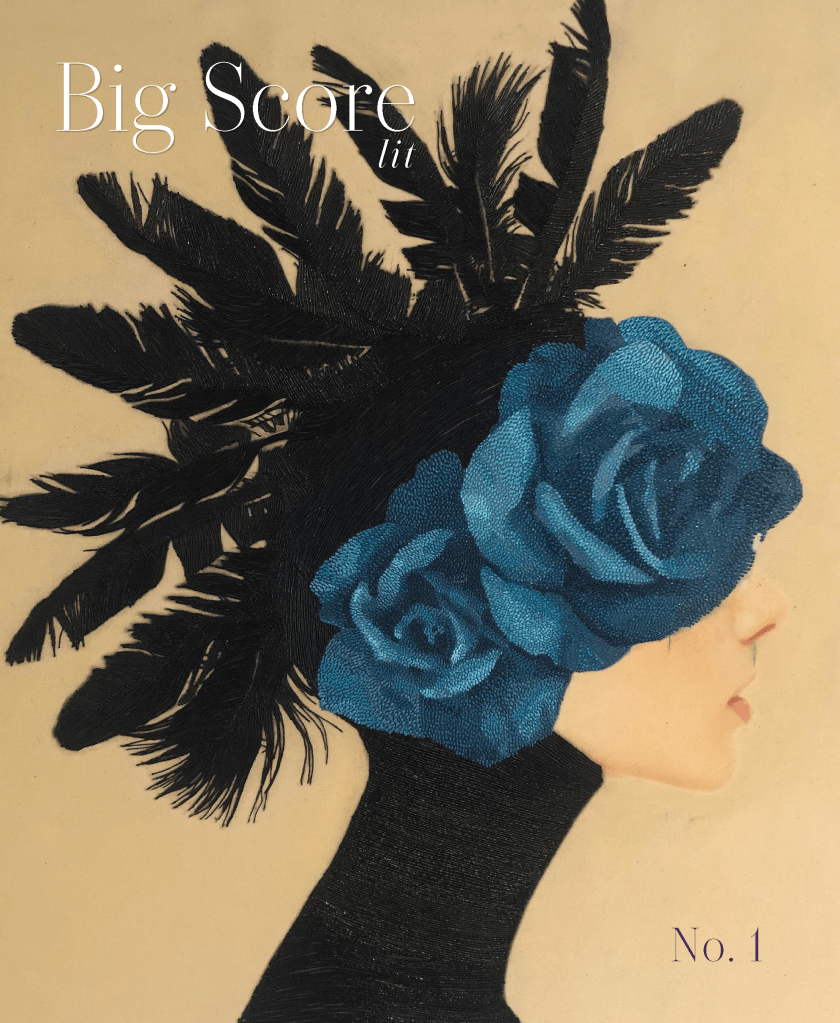
    “Lady Peacock” a painting by Rachel Daly, and the cover image for Big Score No. 1

    Big Score No. 1 cometh…

    Our launch party is set for next Sunday, October 12th, at Gallery 198 in Sunset Park, from 5 – 8 pm. Readings by Cleo Qian, K.P. Taylor, Justin Kamp, and Andres Cordoba. With music from Will Chang. There is a bar, and the current Gallery 198 exhibition features work by AJ Springer. It will be a good time.

    You can subscribe to or make a single issue purchase of Big Score here, which naturally is the best way to support what we’re doing.

    A preview of what No. 1 contains:

    • Dilettantes, a short story by Adora Svitak 

      When we met in college, he was a poet who studied politics. It had been a long time since he had written a poem. While he worked at a public-interest law firm, I pulled novels from my backpack in cafes where disdainful baristas whisked $9 matcha lattes. Reading novels was not my job; I was supposed to be turning my dissertation into a book about modern heterosexuality. I made little progress most days, sitting in noisy cafes and texting friends who had day jobs to ask if they had evening plans.

    • Calf, a poem by Loisa Fenichell
    • Dumpster Fries v. the Monster, a short story by Douglas W. Milliken

      It was one of those late summer mornings where the air itself was gray and lifeless as old burger meat yet nevertheless steamy with oppression (think of the moist breath of a dog who won’t get its panting stink-mouth out of your face) even while the dirt-colored birds were still in the process of waking up to announce their useless wakefulness. You know the kind of day I’m talking about. It sucked before it’d even begun. We were in that old wreck of a house we’d found standing all alone in the brownfields out by the airport, just Jaylee and me packed into a corner of one downstairs room in a matted pile of sleeping bags and grungy clothes and girl. It somehow was and wasn’t exactly as bad as it sounds. Jaylee’d gotten her cast off a few days before but still had some nasty Frankenstein shit stitched up and down her thigh from knee to hip, and she was supposed to be doing physical therapy, too, but that obviously was not going to happen as long as she had to get through each miserable day as a wounded member of the world outside (as opposed to inside) the hospital: since it’d been her asshole stepdad who’d spelled her leg’s ruin with the front end of his Crown Vic, going home was not an option, and since I lost the gamble of revealing to my god-fearing folks that Jaylee was my girl and she needed a place to stay, we were the both of us now unhoused and too focused on surviving one day to the next to worry much about PT sessions or exercises or the dosage and frequency of Jaylee’s cache of fentanyl patches. We were teenagers without homes is all I’m trying to say. Would you be keeping appointments if you’d been us and we’d been you?
    • Barbarians at the Gates?, a poem by Brad Rose
    • An Anatomical Dissection of Depression in a Bo[d]y Offering Itself As Curriculum, a poem by Ismail Yusuf Olumoh
    • Shells, a short story by Wilhemina Austin

      Ralston turned the wheelchair to the right, reached for a cockle shell, pink-streaked. Then he grabbed another with bands of yellow. He was full of the setting sun’s fire. He halted to swoop up one shell after another. He sorted and dismissed, the same as he sorted through the people walking over the sand past us, his voice never low enough. He took the strain of the wheelchair with ease, broad-shouldered as he was, not all that tall, his back well-muscled.

    • The Swimmer in the City: Civics and Semiotics at the Public Pool, a critical essay by Justin Kamp

      Some of my most treasured hours in New York have been spent on the concrete deck of a public pool. My favorite time is just after 5 pm, in the part of midsummer when the afternoon seems impossibly extended, when the daylight idles and eddies before night even begins to take shape. My routine is as follows: I come to the pool directly from work, towel and trunk in bag, sweat usually still sheened over my forehead from the crush of the commute. I shower, stroll out, spread my towel in an opportune stretch of sunlight and sprawl, letting the city’s sub-tropics warm me until I’m kiln-brick hot. Then I don my cap and goggles and ease into the water for a half hour of freestyle. After that, it’s an hour of uninterrupted reading as I dry off in the full late sun before the pool closes at 7.

    • Chicago Sonnet #42, a poem by D. A. Hosek
    • Dead Week, a short story by K.P. Taylor

      NIGHT ONE

      Even Rusty, who usually took no small pleasure in barking orders, had grown almost silent.

      “Lenny,” he huffed, “you work all the live freight?”

      “Weren’t nothin’ to work,” Lenny replied.“How ’bout the backstock?”

      “None of that neither.”

      It was the beginning of Dead Week, that seemingly endless stretch of dull nights between Christmas and New Year’s Eve with nothing to do and too many hours to fill doing it. Rusty scanned the backroom, searching desperately for something, anything, for Lenny to do. Every last bag of stuffing had already found its way to the discount rack, and all the bottles of cheap champagne had claimed their places on the endcaps.

      “Ya know what?” Lenny offered, preferring to jump rather than be pushed. “I could head over to Aisle 7. There’s some cans of Friskies and Fancy Feast I could front.”

      “Why don’t you go on over to Aisle 7, Lenny,” Rusty said, as if it had been his idea.

      Lenny made a big show of wheeling an empty U-boat out with him.
    • Oh the Passion, a poem by T.A.R. Wallace
    • When You Become a Witch in a Nigerian Home, a poem by CP Nwankwo
    • When Love Speaks Yoruba and English, a short story by Solape Adetutu Adeyemi

      I.

      I remember the first time I fell in love. It was with a boy who didn’t know how to say I love you in Yoruba. That should have been my first clue that things would break.

      His name was Tobi. We met at a poetry open mic at Terra Kulture in Lagos. I was twenty-two, fresh out of university, clutching my brown leather notebook like it contained my entire worth. I hadn’t written anything good in months, but I needed to be surrounded by people who still believed words could save us.
    • The Things We Hang Onto, a poem by Oladosu Michael Emerald
    • Waiting, a poem by Cleo Xian
  • Where to start?


    With a simple enough premise: writers deserve to be paid. Writers of poetry and of narrative prose and of criticism. The work is driven by personal passion in a way that so much of what passes for “work” in our day and age is not — and yet those folks coasting along doing their empty little nothings receive salary plus a 401k?* We call bullshit! 


    And what else? Writers deserve for their work to be evaluated independently of any preexisting platform. Big Score wants to publish your work, not your social media numbers.


    Meaning we read our submissions with the author’s identity hidden.


    Finally? Lest we forget, narrative has the power to define not only our personal lives, but also, at the world scale, the age in which we live. Perhaps because the pursuit of meaningful work has blurred too much with a corporate-infused mentality—that snake devouring its own tail—we seem to have collectively forgotten somewhere along the way that there really can be no such thing as a great author without great criticism. That’s why Big Score pays for critical work at the same level as we do fiction and narrative prose. (And we’re not skimping for poetry either.)


    Now: it’s late in the game, seemingly we’re 47 points down, and facing off against the opponent’s meathead constellation of pursuers… here we fall back, all by our lonesomes, deep in the pocket, just a few steps beyond their reach… Keep scrambling, good things happen when we scramble. We’re here to do what we’re here to do. Feeling like that ball might fly forever once it leaves our fingertips.


    This is work that matters. Big Score is a machine for rewarding writers for their work.

    * we regret that despite our best efforts, off and on the field, we are unable to provide our writers with 401ks—only $400 for narrative prose, $100 per poem, and a $400 base rate for criticism